Hi all, well finally I have the piece for Lisa's fabulous book finished! There's lots going on here so let's take a look shall we?
Welcome to...
The Descendents of the Dragon!
This piece takes a small peek into some of the background that lies underneath modern Chinese culture and beliefs. The term descendents of the dragon is one in which chinese people have long used to refer to themselves. The culture of the world's oldest continuous civilisation is rather a large and impressive one. In researching chinese cultural history I wondered at what beliefs and practices had changed over thousands of years. In the end I had so much information I had to hone it down to something useable within a book confine and also consider the support material required to do justice to the concepts I wanted to depict. What eventuated here is just a small sample from a very large bag of possibilities.
To begin a set of doors.
I love the idea of opening a door and being transported to some place else.
The door design is taken from one in the forbidden city.
Under the door is a page describing the background behind the concepts of the piece.

We'll skip that and over we go and...
Meet Long, the chinese dragon.

The chinese dragon is symbolic of strength, power, and good luck. It is frequently depicted with a flaming pearl under its chin. The pearl represents wealth, good luck and prosperity. The five toed dragon here was used as a symbol reserved exclusively for the chinese emperor. The dragon is constructed from layers of fabric paper and sits on a piece of yellow satin. Much richer in person than it looks here (which is very washed out, trying to beat the glare from photography is difficult) yellow is regarded as the centre of all colour and was able to be worn only by the emperor. The flame is made using strands of silk fibres.
Opposite the dragon is the key book. The book is the depository of the remainder of the piece within the book structure.
Here it is attached to the structure.

and again free of the confines.

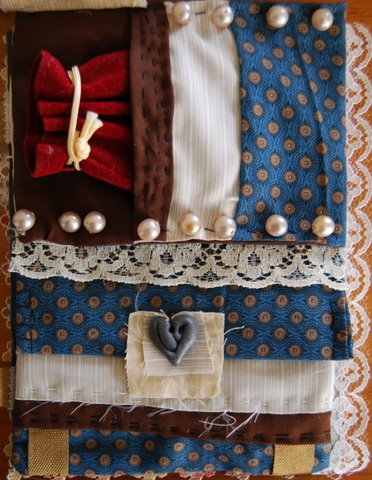
Constructed of small quilts which are sewn together to form pages of the book, the key book is made from a variety of fabrics including silks, satins, cotton, a few man made pieces and silk brocades. Each item used as an embellishment here and the colour of those items has been chosen to symbollically support the concepts of the page on which it sits. The beads used in the book are a combination of lapidolite, amethyst, coral, freshwater pearls, seeds, bone and wood. Each page also has a quote attached, chosen to support the concepts of the page, although those concepts may be a little obscure by western standards. The quotes, all except the last page are pieces of poetry. Poetry in chinese culture is regarded as the pinnacle of literature and none is more highly regarded than Tang dynasty poetry. Many of the pieces used here were written by Li Bai, a master of the art form from the Tang period. In an effort to also support the book concepts all the paper used here was sourced from China. Modern paper was developed in China in around 105AD and is considered one of the four great inventions of ancient China.

Onto the book .
The first page depicts the Jade Emperor. The picture is a transfer onto a piece of very fragile vintage silk. I admit to a few heart stopping moments during the transfer process, but yay it all worked in the end. Black and blue are the primary embellishment colours here, black representing the heavens whilst azure blue is considered to be the colour of the skies under heaven.

On the opposite page a representation of the bi disk. Bi are a circular disc with a central circular hole. Bi date back to the neolithic period of chinese history. Originally produced from stone, mostly jade, other examples have been found produced from agate, rock crystal, quartz and in subsequent periods glass. Bi produced in later periods were decorated with ornaments. The size, shape meaning and symbolism of Bi changed over millenia and was accorded different meanings and valuations under different dynasties. The original function and significance is unknown as it predates written history. Bi were frequently found buried with the dead and are considered a sky or heavenly symbol. In the Zhou dynasty (1045-256 BC) Bi discs of defeated forces were handed over to the victor as a sign of submission. In later dynastic periods bi discs have been used to indicate an individual of moral quality and have served as an important symbol of rank.

The disc used here is made from polished agate. The colours of yellow and brown are associated with the earth.
The next page shows a piece of silk brocade depicting the lotus. The lotus is one of the eight auspicious symbols of the buddhist religion and symbolises purity, beauty and perfection. The small round beads on th page are lotus seeds and are carved with the face of the Buddha. the larger bead shows a hand carved lotus flower and comes from Tibet.

On the opposite page, the Pan Chang knot. Chinese decorative knotting began as a form of folk art in the Tang dynasty. Popularised under the Ming and Qing dynasties it flourished until the end of imperial China where the art was almost completely lost. This was exaccerbated by the perishability of the materials used in the art. A resurgence of interest in the late 1970's ocurred when focus on preserving knotting artefacts of the Qing Dynasty became the focus of the National Palace Museum in Taiwan. The piece displays a Pan Chang knot. Also known as the endless knot the Pan Chang is the eighth auspicious symbol of the Buddhist religion and signifies harmony, success and constancy. It is thus a token auguring long life, happiness, continuation of the family line, prosperity, abundant financial resources and friendship of deep and lasting affection. No wonder it is so well regaled in chinese culture. The page decoration colour here is red symbolising good luck and prosperity. The beads including the branch shaped piece are all made from coral with the exception of the bamboo piece inscribed with chinese characters pertaining to good luck and fortune.

The next page relates to the introduction of coinage in chinese society. Chinese coins were produced by casting rather than struck with dies as in most western currency. They are valued for their reflection on the rise and fall of the dynasties in which they were produced as well as for the beauty of their calligaphy and the patinas they produce. Although a number of types of materials have been used in Chinese culture as monetary exchange, the term coin usually refers to the round coin (qian), knife mooney (dao) and spade money (bu). The two coins here are of the round and spade types. The spade coin was produced during the era of Wang Mang (10-14 AD) in the Xin dynasty, while the round coin is from the Tang era produced under Li Yuan (reign title T'ang Kao Tsu 618-626 AD) The distinguishing colour used here is purple depicting metal. The beads are lepidolite and amethyst.

The last page represents silk painting and literature in chinese culture. Silk painting dates back to the Neolithic age approximately 6000 years ago and was developed long before the use of paper. Chinese painting is generally divided into several groups based on form, technique and subject. The material here depicting the image of five men is an ink and wash painting on silk and is a fragment from a long horizontal scroll which originally measured over three and a half metres in length. The scroll depicts the story of Shi Hu Zuan or the Water Margin. Also known as the Outlaws of the Marsh (there is some variance in translation), Shi Hu Zuan was written in the 13th century and is regarded as one of the four classic novels of chinese literature. The story relates the tale of Song Jian and the 108 outlaws who comprise his band of renegades who fight corruption and injustice. The renegades come from all levels of chinese society and eventually seek refuge at Mount Liang and the surrounding marshlands. The tales are supposed to have a basis in historical fact and indeed there is record of a Song Jian and his band recorded in the official histories relating to the Song Dynasty. The five men here depict five of the outlaws of Song Jian's band. Due to water damage (not caused by me!) the coloured wash has bled at some stage but the depiction of the figures in ink is still clear to see. The quote on this page is a translation from the chinese novel.

As you can see there is much symbolism attached to the items used in the book. In order for viewers of the piece to understand these elements I decided to create a scroll, made from linen, paper and silk, onto which I have put together the background of the piece and is designed to be read in conjunction with the viewing of the key book.

Reaching over two metres in length (although only approximately 15 cm high), the scroll was too large to place within the confines of Lisa's book structure and so I have made a bag of red silk and black satin to house the scroll. So now the book has it's own wee doggie baggie to carry around with it, LOL!
Here's a look at the finshed items. Lots of glare from the painted doors, silk and satin, sigh! A photography nightmare if you are camera challenged like me!

This was quite a fun piece to do.
I loved working on the piece and I hope Lisa likes it too. It's quite a bit different to the other work in the book so far, but different is good, Right?
Well now I'm off to package it all up and it will be winging it's way to Alicia in the next few days.
For now onto the next book!


 Posts
Posts


 detail of the collage...
 if you want to see the rest, head on over to my blog: http://alteredbits.wordpress.com